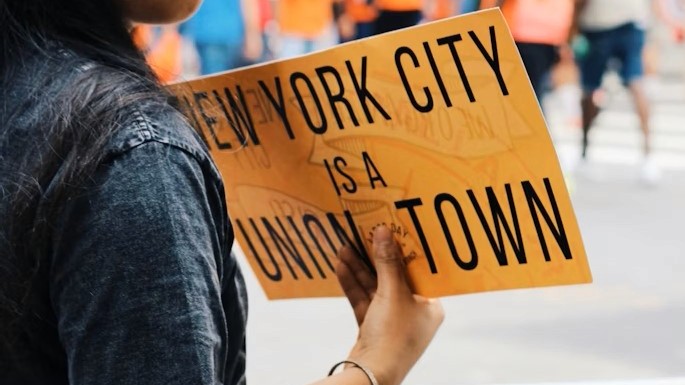
On May Day, Mayor Zohran Mamdani posted a slickly produced video with the tagline that “there is no NYC without unions,” featuring images of proud public workers “showing the world what solidarity means.” It’s a fine sentiment, but it’s not quite right. There is no New York City without government workers. But the city thrived for generations without powerful unions to represent those workers.
In fact, public-sector unions are relative newcomers to the labor movement. Before the 1960s, the few that existed were small and weak. Walkouts were rare; when they occurred, the disruption of public services could provoke backlash, as occurred after the 1919 Boston police strike.
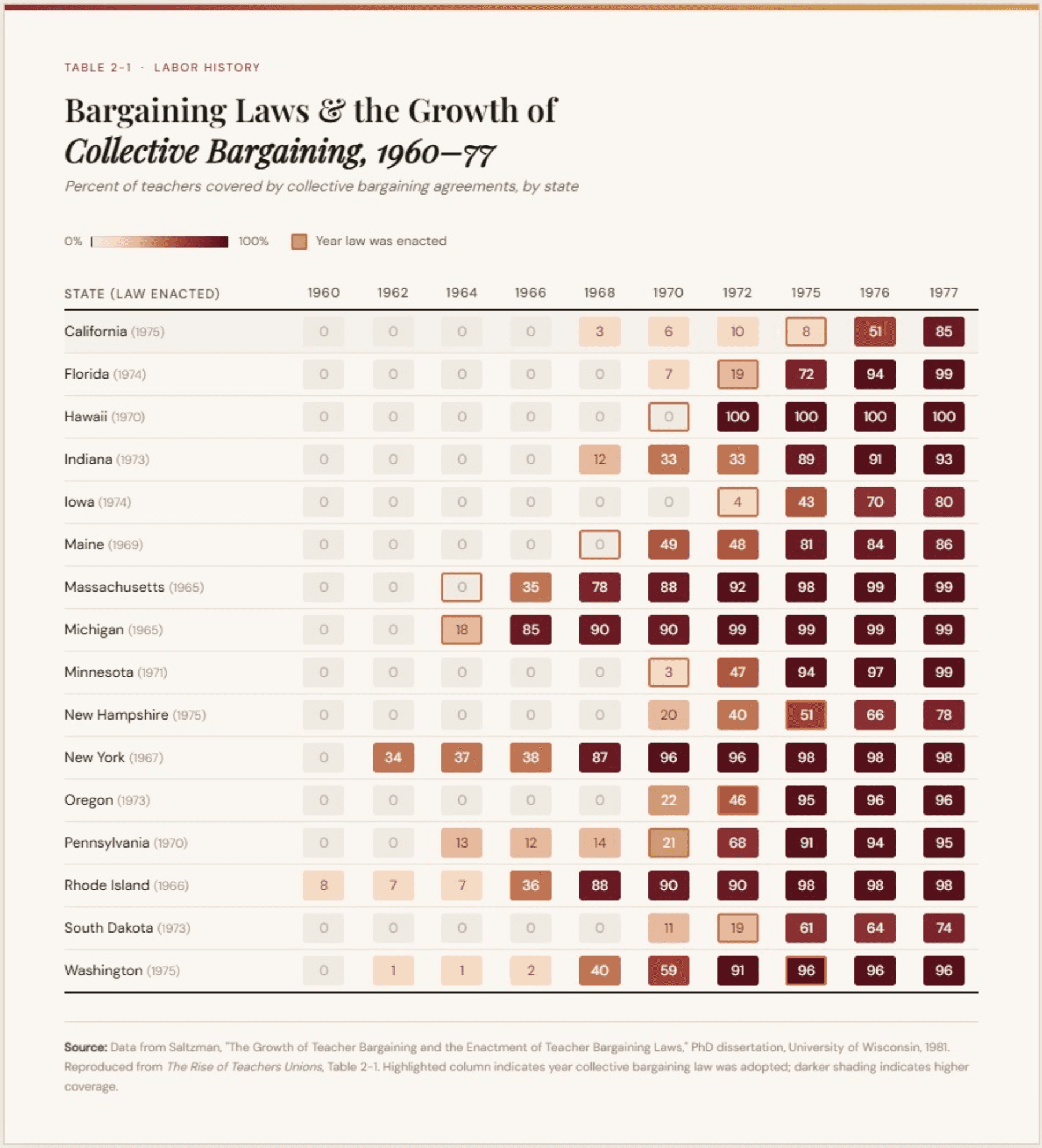
Modern public-sector unions as we know them today emerged only in the late 1960s and 1970s. They did not arise organically. Instead, they were called into being by a rash of state laws requiring municipalities to bargain collectively. This chart documenting the rise of teachers’ unions, which I lifted from Terry Moe’s “Special Interest,” is quite something:
The modern public-sector union is entirely a creature of law. And it was something new under the sun. For decades, judges and public officials had insisted that collective bargaining would cede sovereign power to private organizations whose interests diverged from the community at large. In 1971, two Yale law professors, Harry Wellington and Ralph Winter, refined that argument in a prescient book called “The Unions and the Cities.”
Wellington and Winter cautioned against extending arguments in favor of private-sector unions to the public sector. In the private sector, they noted, unions are disciplined by the market: They share with their employers an interest in the success of the collective enterprise. Demands that make it impossible to compete would be bad for business and, ultimately, bad for workers.
Public-sector unions, in contrast, are constrained only by politics. Elected officials are supposed to represent the voters, but the public is disinterested in the minutiae of local elections. Unions, in contrast, care a lot about who’s sitting across the negotiating table and often have the clout to get them elected.
Institutionalizing the power of public-sector unions, Wellington and Winter feared, “would leave competing groups in the political process at a permanent and substantial disadvantage.” They were right to worry. As early as 1975, one union leader in New York City was blunt: “We have the ability, in a sense, to elect our own boss.”
So it remains today. In states with collective bargaining, public-sector unions are the most potent force in city elections. In the 2023-2024 cycle alone, the four biggest unions representing government workers spent a whopping $915 million on politics. Union power is felt most acutely during primary elections, when the public is disengaged and candidates jockey for union endorsements and campaign dollars. And in most cities, the primary is the ballgame.
Election timing can further amplify union influence. Sarah Anzia, a Berkeley political scientist, has shown that teacher pay is higher in districts with school boards that are elected in off-year elections, when the public is paying even less attention than usual. What’s more, collective-bargaining agreements often extend past a mayor’s term. The next mayor may be elected on the promise to fix failing schools or a rotten police force — only to find his or her hands tied.
Union power has real advantages. Public employees deserve good wages, safe working conditions and protections from political reprisal. Especially as American cities become increasingly unaffordable, unions can discourage attempts to economize on the backs of the middle class. They can also force officials to confront real problems in the delivery of government services: employee burnout, abusive supervisors, untenable workloads and more.
Politicians elected with union backing, however, are under intense pressure to enter into labor contracts that are good for the unions and bad for the public. Yes, improvident labor deals may yield bloated budgets and crappy public services. But the diffuse frustration over a poorly managed city is nothing to the white-hot rage of the unions. The public does care about high taxes, which puts an upper limit on wage increases. But that just encourages officials to placate unions with lax work rules and generous pensions and health benefits, as Robert Gordon and I discussed in a recent New York Times op-ed.
What’s happening in New York exemplifies the problem. In Albany, public-sector unions are pushing for legislation that would allow government workers to retire at age 55 with full pensions after 30 years of service. That would be an unthinkable deal for most Americans. It would also saddle a cash-strapped New York City with fiscal obligations that will frustrate Mamdani’s efforts to implement his most ambitious policy proposals, including universal child care.
At the same time, the Metropolitan Transit Authority is locked in a bitter fight with the unions that represent Long Island Rail Road workers. Among the key hang-ups are arbitrary work rules that require double and sometimes even triple pay for a single day’s work.
The costs of collective bargaining may partly explain why blue cities in red states — David Brooks calls them “red-blue mash-ups” — are growing faster than blue cities in blue states. Most of that growth is a function of business climate and housing markets, of course; it’s still cheaper to live in Houston than Los Angeles. But red-blue cities also tend to have lower taxes than blue-blue cities, in part because they are less burdened by legacy pension obligations.
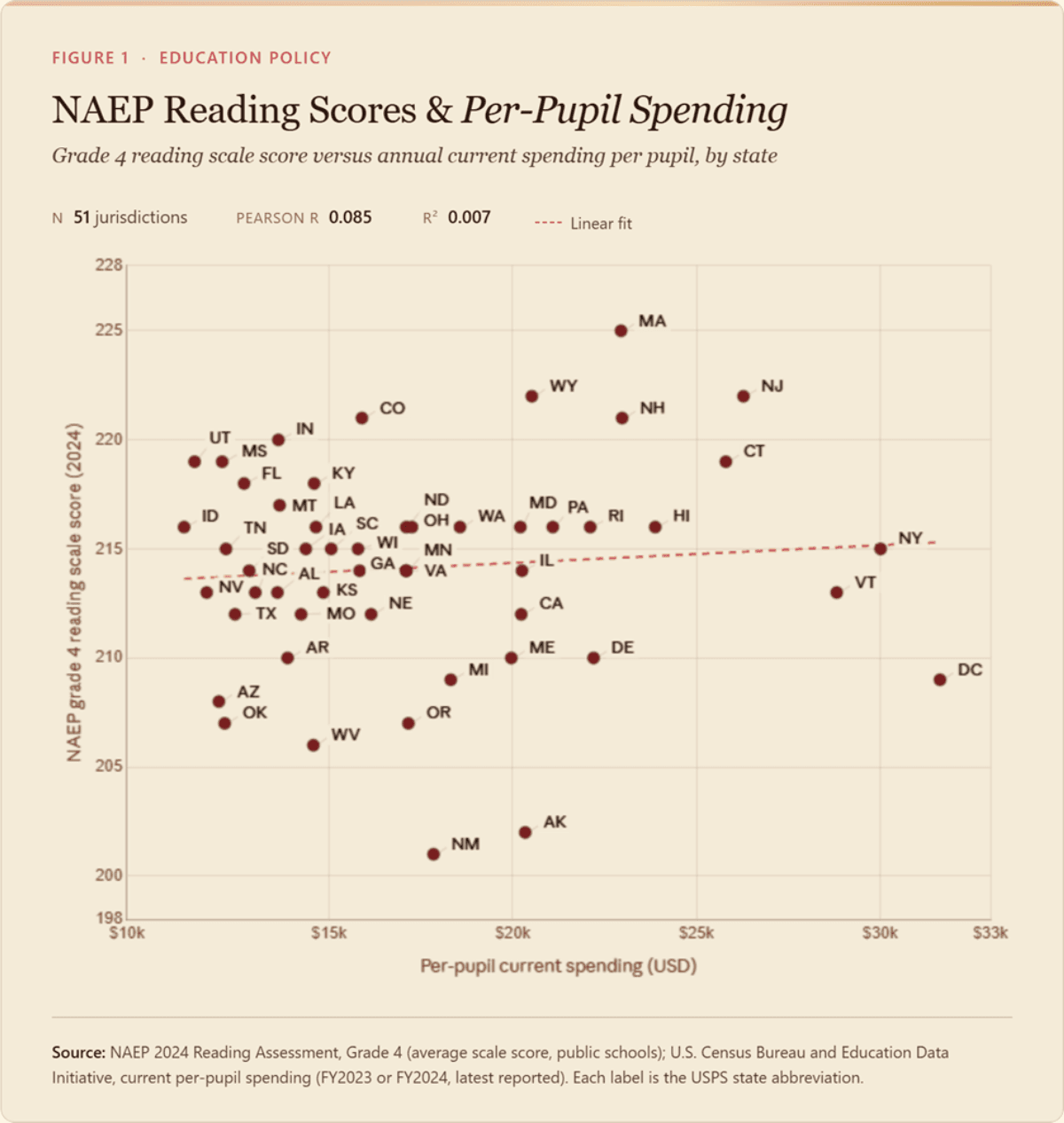
Though this is more speculative, blue cities in red states may deliver public services more efficiently. Per-pupil spending, for example, is a poor predictor of educational performance across states. But red states cluster on the low-spending left half of this graph, and blue states on the high-spending right.
In New York City, spending is around $40,000 per pupil. That’s likely to rise further under a rigid and expensive union-backed law requiring smaller class sizes across all the city’s schools. Student performance is middling.
In short, laws that require collective bargaining created modern public-sector unions. Those unions then exploit their legal privilege to dominate urban politics, often at the public’s expense.
That dynamic isn’t unique to unions. The corporate form, for example, is also a legal privilege with major electoral consequences. But only public-sector unions have a monopoly on negotiating labor contracts that immediately affect both the quality of public services and city finances.
It’s tempting to try to solve the problem by prohibiting unions from injecting money into politics. After Citizens United, however, efforts to cap unions’ independent spending will run into a brick wall.
But collective bargaining doesn’t have to be all-or-nothing. Lawmakers can pick and choose what unions can negotiate over. Unions play a salutary role in pushing for competitive salaries, for example, which is essential to attracting a high-quality public workforce. It’s more troubling when they demand work rules that erode accountability and degrade public services. It’s also worrisome when unions press elected officials to shift compensation into pensions and health benefits that are obscure to voters and whose costs will only become apparent decades down the line.
Why not limit public-sector unions to negotiating over wages? It’s not a fanciful proposal; that’s what Wisconsin did in 2011. Wisconsin’s law went too far in some respects and not far enough in others; its exception for police and firefighter unions was unprincipled, and it has now drawn a serious equal-protection challenge. But the idea has much to be said for it.
Whatever the right approach may be, Democrats who worry about public safety, urban schools and the fiscal health of our cities ought to be open to rethinking the bargain we struck with public-sector unions five decades ago. Just 7.3 million people belong to public-sector unions, or about 2% of the population. They deserve a voice in our politics. But they shouldn’t have the power to shout the rest of us down.
Editor's Note: This piece has been cross-posted at Vital City.
On May Day, Mayor Zohran Mamdani posted a slickly produced video with the tagline that “there is no NYC without unions,” featuring images of proud public workers “showing the world what solidarity means.” It’s a fine sentiment, but it’s not quite right. There is no New York City without government workers. But the city thrived for generations without powerful unions to represent those workers.
In fact, public-sector unions are relative newcomers to the labor movement. Before the 1960s, the few that existed were small and weak. Walkouts were rare; when they occurred, the disruption of public services could provoke backlash, as occurred after the 1919 Boston police strike.
Modern public-sector unions as we know them today emerged only in the late 1960s and 1970s. They did not arise organically. Instead, they were called into being by a rash of state laws requiring municipalities to bargain collectively. This chart documenting the rise of teachers’ unions, which I lifted from Terry Moe’s “Special Interest,” is quite something:
The modern public-sector union is entirely a creature of law. And it was something new under the sun. For decades, judges and public officials had insisted that collective bargaining would cede sovereign power to private organizations whose interests diverged from the community at large. In 1971, two Yale law professors, Harry Wellington and Ralph Winter, refined that argument in a prescient book called “The Unions and the Cities.”
Wellington and Winter cautioned against extending arguments in favor of private-sector unions to the public sector. In the private sector, they noted, unions are disciplined by the market: They share with their employers an interest in the success of the collective enterprise. Demands that make it impossible to compete would be bad for business and, ultimately, bad for workers.
Public-sector unions, in contrast, are constrained only by politics. Elected officials are supposed to represent the voters, but the public is disinterested in the minutiae of local elections. Unions, in contrast, care a lot about who’s sitting across the negotiating table and often have the clout to get them elected.
Institutionalizing the power of public-sector unions, Wellington and Winter feared, “would leave competing groups in the political process at a permanent and substantial disadvantage.” They were right to worry. As early as 1975, one union leader in New York City was blunt: “We have the ability, in a sense, to elect our own boss.”
So it remains today. In states with collective bargaining, public-sector unions are the most potent force in city elections. In the 2023-2024 cycle alone, the four biggest unions representing government workers spent a whopping $915 million on politics. Union power is felt most acutely during primary elections, when the public is disengaged and candidates jockey for union endorsements and campaign dollars. And in most cities, the primary is the ballgame.
Election timing can further amplify union influence. Sarah Anzia, a Berkeley political scientist, has shown that teacher pay is higher in districts with school boards that are elected in off-year elections, when the public is paying even less attention than usual. What’s more, collective-bargaining agreements often extend past a mayor’s term. The next mayor may be elected on the promise to fix failing schools or a rotten police force — only to find his or her hands tied.
Union power has real advantages. Public employees deserve good wages, safe working conditions and protections from political reprisal. Especially as American cities become increasingly unaffordable, unions can discourage attempts to economize on the backs of the middle class. They can also force officials to confront real problems in the delivery of government services: employee burnout, abusive supervisors, untenable workloads and more.
Politicians elected with union backing, however, are under intense pressure to enter into labor contracts that are good for the unions and bad for the public. Yes, improvident labor deals may yield bloated budgets and crappy public services. But the diffuse frustration over a poorly managed city is nothing to the white-hot rage of the unions. The public does care about high taxes, which puts an upper limit on wage increases. But that just encourages officials to placate unions with lax work rules and generous pensions and health benefits, as Robert Gordon and I discussed in a recent New York Times op-ed.
What’s happening in New York exemplifies the problem. In Albany, public-sector unions are pushing for legislation that would allow government workers to retire at age 55 with full pensions after 30 years of service. That would be an unthinkable deal for most Americans. It would also saddle a cash-strapped New York City with fiscal obligations that will frustrate Mamdani’s efforts to implement his most ambitious policy proposals, including universal child care.
At the same time, the Metropolitan Transit Authority is locked in a bitter fight with the unions that represent Long Island Rail Road workers. Among the key hang-ups are arbitrary work rules that require double and sometimes even triple pay for a single day’s work.
The costs of collective bargaining may partly explain why blue cities in red states — David Brooks calls them “red-blue mash-ups” — are growing faster than blue cities in blue states. Most of that growth is a function of business climate and housing markets, of course; it’s still cheaper to live in Houston than Los Angeles. But red-blue cities also tend to have lower taxes than blue-blue cities, in part because they are less burdened by legacy pension obligations.
Though this is more speculative, blue cities in red states may deliver public services more efficiently. Per-pupil spending, for example, is a poor predictor of educational performance across states. But red states cluster on the low-spending left half of this graph, and blue states on the high-spending right.
In New York City, spending is around $40,000 per pupil. That’s likely to rise further under a rigid and expensive union-backed law requiring smaller class sizes across all the city’s schools. Student performance is middling.
In short, laws that require collective bargaining created modern public-sector unions. Those unions then exploit their legal privilege to dominate urban politics, often at the public’s expense.
That dynamic isn’t unique to unions. The corporate form, for example, is also a legal privilege with major electoral consequences. But only public-sector unions have a monopoly on negotiating labor contracts that immediately affect both the quality of public services and city finances.
It’s tempting to try to solve the problem by prohibiting unions from injecting money into politics. After Citizens United, however, efforts to cap unions’ independent spending will run into a brick wall.
But collective bargaining doesn’t have to be all-or-nothing. Lawmakers can pick and choose what unions can negotiate over. Unions play a salutary role in pushing for competitive salaries, for example, which is essential to attracting a high-quality public workforce. It’s more troubling when they demand work rules that erode accountability and degrade public services. It’s also worrisome when unions press elected officials to shift compensation into pensions and health benefits that are obscure to voters and whose costs will only become apparent decades down the line.
Why not limit public-sector unions to negotiating over wages? It’s not a fanciful proposal; that’s what Wisconsin did in 2011. Wisconsin’s law went too far in some respects and not far enough in others; its exception for police and firefighter unions was unprincipled, and it has now drawn a serious equal-protection challenge. But the idea has much to be said for it.
Whatever the right approach may be, Democrats who worry about public safety, urban schools and the fiscal health of our cities ought to be open to rethinking the bargain we struck with public-sector unions five decades ago. Just 7.3 million people belong to public-sector unions, or about 2% of the population. They deserve a voice in our politics. But they shouldn’t have the power to shout the rest of us down.
Editor's Note: This piece has been cross-posted at Vital City.
On May Day, Mayor Zohran Mamdani posted a slickly produced video with the tagline that “there is no NYC without unions,” featuring images of proud public workers “showing the world what solidarity means.” It’s a fine sentiment, but it’s not quite right. There is no New York City without government workers. But the city thrived for generations without powerful unions to represent those workers.
In fact, public-sector unions are relative newcomers to the labor movement. Before the 1960s, the few that existed were small and weak. Walkouts were rare; when they occurred, the disruption of public services could provoke backlash, as occurred after the 1919 Boston police strike.
Modern public-sector unions as we know them today emerged only in the late 1960s and 1970s. They did not arise organically. Instead, they were called into being by a rash of state laws requiring municipalities to bargain collectively. This chart documenting the rise of teachers’ unions, which I lifted from Terry Moe’s “Special Interest,” is quite something:
The modern public-sector union is entirely a creature of law. And it was something new under the sun. For decades, judges and public officials had insisted that collective bargaining would cede sovereign power to private organizations whose interests diverged from the community at large. In 1971, two Yale law professors, Harry Wellington and Ralph Winter, refined that argument in a prescient book called “The Unions and the Cities.”
Wellington and Winter cautioned against extending arguments in favor of private-sector unions to the public sector. In the private sector, they noted, unions are disciplined by the market: They share with their employers an interest in the success of the collective enterprise. Demands that make it impossible to compete would be bad for business and, ultimately, bad for workers.
Public-sector unions, in contrast, are constrained only by politics. Elected officials are supposed to represent the voters, but the public is disinterested in the minutiae of local elections. Unions, in contrast, care a lot about who’s sitting across the negotiating table and often have the clout to get them elected.
Institutionalizing the power of public-sector unions, Wellington and Winter feared, “would leave competing groups in the political process at a permanent and substantial disadvantage.” They were right to worry. As early as 1975, one union leader in New York City was blunt: “We have the ability, in a sense, to elect our own boss.”
So it remains today. In states with collective bargaining, public-sector unions are the most potent force in city elections. In the 2023-2024 cycle alone, the four biggest unions representing government workers spent a whopping $915 million on politics. Union power is felt most acutely during primary elections, when the public is disengaged and candidates jockey for union endorsements and campaign dollars. And in most cities, the primary is the ballgame.
Election timing can further amplify union influence. Sarah Anzia, a Berkeley political scientist, has shown that teacher pay is higher in districts with school boards that are elected in off-year elections, when the public is paying even less attention than usual. What’s more, collective-bargaining agreements often extend past a mayor’s term. The next mayor may be elected on the promise to fix failing schools or a rotten police force — only to find his or her hands tied.
Union power has real advantages. Public employees deserve good wages, safe working conditions and protections from political reprisal. Especially as American cities become increasingly unaffordable, unions can discourage attempts to economize on the backs of the middle class. They can also force officials to confront real problems in the delivery of government services: employee burnout, abusive supervisors, untenable workloads and more.
Politicians elected with union backing, however, are under intense pressure to enter into labor contracts that are good for the unions and bad for the public. Yes, improvident labor deals may yield bloated budgets and crappy public services. But the diffuse frustration over a poorly managed city is nothing to the white-hot rage of the unions. The public does care about high taxes, which puts an upper limit on wage increases. But that just encourages officials to placate unions with lax work rules and generous pensions and health benefits, as Robert Gordon and I discussed in a recent New York Times op-ed.
What’s happening in New York exemplifies the problem. In Albany, public-sector unions are pushing for legislation that would allow government workers to retire at age 55 with full pensions after 30 years of service. That would be an unthinkable deal for most Americans. It would also saddle a cash-strapped New York City with fiscal obligations that will frustrate Mamdani’s efforts to implement his most ambitious policy proposals, including universal child care.
At the same time, the Metropolitan Transit Authority is locked in a bitter fight with the unions that represent Long Island Rail Road workers. Among the key hang-ups are arbitrary work rules that require double and sometimes even triple pay for a single day’s work.
The costs of collective bargaining may partly explain why blue cities in red states — David Brooks calls them “red-blue mash-ups” — are growing faster than blue cities in blue states. Most of that growth is a function of business climate and housing markets, of course; it’s still cheaper to live in Houston than Los Angeles. But red-blue cities also tend to have lower taxes than blue-blue cities, in part because they are less burdened by legacy pension obligations.
Though this is more speculative, blue cities in red states may deliver public services more efficiently. Per-pupil spending, for example, is a poor predictor of educational performance across states. But red states cluster on the low-spending left half of this graph, and blue states on the high-spending right.
In New York City, spending is around $40,000 per pupil. That’s likely to rise further under a rigid and expensive union-backed law requiring smaller class sizes across all the city’s schools. Student performance is middling.
In short, laws that require collective bargaining created modern public-sector unions. Those unions then exploit their legal privilege to dominate urban politics, often at the public’s expense.
That dynamic isn’t unique to unions. The corporate form, for example, is also a legal privilege with major electoral consequences. But only public-sector unions have a monopoly on negotiating labor contracts that immediately affect both the quality of public services and city finances.
It’s tempting to try to solve the problem by prohibiting unions from injecting money into politics. After Citizens United, however, efforts to cap unions’ independent spending will run into a brick wall.
But collective bargaining doesn’t have to be all-or-nothing. Lawmakers can pick and choose what unions can negotiate over. Unions play a salutary role in pushing for competitive salaries, for example, which is essential to attracting a high-quality public workforce. It’s more troubling when they demand work rules that erode accountability and degrade public services. It’s also worrisome when unions press elected officials to shift compensation into pensions and health benefits that are obscure to voters and whose costs will only become apparent decades down the line.
Why not limit public-sector unions to negotiating over wages? It’s not a fanciful proposal; that’s what Wisconsin did in 2011. Wisconsin’s law went too far in some respects and not far enough in others; its exception for police and firefighter unions was unprincipled, and it has now drawn a serious equal-protection challenge. But the idea has much to be said for it.
Whatever the right approach may be, Democrats who worry about public safety, urban schools and the fiscal health of our cities ought to be open to rethinking the bargain we struck with public-sector unions five decades ago. Just 7.3 million people belong to public-sector unions, or about 2% of the population. They deserve a voice in our politics. But they shouldn’t have the power to shout the rest of us down.
Editor's Note: This piece has been cross-posted at Vital City.
On May Day, Mayor Zohran Mamdani posted a slickly produced video with the tagline that “there is no NYC without unions,” featuring images of proud public workers “showing the world what solidarity means.” It’s a fine sentiment, but it’s not quite right. There is no New York City without government workers. But the city thrived for generations without powerful unions to represent those workers.
In fact, public-sector unions are relative newcomers to the labor movement. Before the 1960s, the few that existed were small and weak. Walkouts were rare; when they occurred, the disruption of public services could provoke backlash, as occurred after the 1919 Boston police strike.
Modern public-sector unions as we know them today emerged only in the late 1960s and 1970s. They did not arise organically. Instead, they were called into being by a rash of state laws requiring municipalities to bargain collectively. This chart documenting the rise of teachers’ unions, which I lifted from Terry Moe’s “Special Interest,” is quite something:
The modern public-sector union is entirely a creature of law. And it was something new under the sun. For decades, judges and public officials had insisted that collective bargaining would cede sovereign power to private organizations whose interests diverged from the community at large. In 1971, two Yale law professors, Harry Wellington and Ralph Winter, refined that argument in a prescient book called “The Unions and the Cities.”
Wellington and Winter cautioned against extending arguments in favor of private-sector unions to the public sector. In the private sector, they noted, unions are disciplined by the market: They share with their employers an interest in the success of the collective enterprise. Demands that make it impossible to compete would be bad for business and, ultimately, bad for workers.
Public-sector unions, in contrast, are constrained only by politics. Elected officials are supposed to represent the voters, but the public is disinterested in the minutiae of local elections. Unions, in contrast, care a lot about who’s sitting across the negotiating table and often have the clout to get them elected.
Institutionalizing the power of public-sector unions, Wellington and Winter feared, “would leave competing groups in the political process at a permanent and substantial disadvantage.” They were right to worry. As early as 1975, one union leader in New York City was blunt: “We have the ability, in a sense, to elect our own boss.”
So it remains today. In states with collective bargaining, public-sector unions are the most potent force in city elections. In the 2023-2024 cycle alone, the four biggest unions representing government workers spent a whopping $915 million on politics. Union power is felt most acutely during primary elections, when the public is disengaged and candidates jockey for union endorsements and campaign dollars. And in most cities, the primary is the ballgame.
Election timing can further amplify union influence. Sarah Anzia, a Berkeley political scientist, has shown that teacher pay is higher in districts with school boards that are elected in off-year elections, when the public is paying even less attention than usual. What’s more, collective-bargaining agreements often extend past a mayor’s term. The next mayor may be elected on the promise to fix failing schools or a rotten police force — only to find his or her hands tied.
Union power has real advantages. Public employees deserve good wages, safe working conditions and protections from political reprisal. Especially as American cities become increasingly unaffordable, unions can discourage attempts to economize on the backs of the middle class. They can also force officials to confront real problems in the delivery of government services: employee burnout, abusive supervisors, untenable workloads and more.
Politicians elected with union backing, however, are under intense pressure to enter into labor contracts that are good for the unions and bad for the public. Yes, improvident labor deals may yield bloated budgets and crappy public services. But the diffuse frustration over a poorly managed city is nothing to the white-hot rage of the unions. The public does care about high taxes, which puts an upper limit on wage increases. But that just encourages officials to placate unions with lax work rules and generous pensions and health benefits, as Robert Gordon and I discussed in a recent New York Times op-ed.
What’s happening in New York exemplifies the problem. In Albany, public-sector unions are pushing for legislation that would allow government workers to retire at age 55 with full pensions after 30 years of service. That would be an unthinkable deal for most Americans. It would also saddle a cash-strapped New York City with fiscal obligations that will frustrate Mamdani’s efforts to implement his most ambitious policy proposals, including universal child care.
At the same time, the Metropolitan Transit Authority is locked in a bitter fight with the unions that represent Long Island Rail Road workers. Among the key hang-ups are arbitrary work rules that require double and sometimes even triple pay for a single day’s work.
The costs of collective bargaining may partly explain why blue cities in red states — David Brooks calls them “red-blue mash-ups” — are growing faster than blue cities in blue states. Most of that growth is a function of business climate and housing markets, of course; it’s still cheaper to live in Houston than Los Angeles. But red-blue cities also tend to have lower taxes than blue-blue cities, in part because they are less burdened by legacy pension obligations.
Though this is more speculative, blue cities in red states may deliver public services more efficiently. Per-pupil spending, for example, is a poor predictor of educational performance across states. But red states cluster on the low-spending left half of this graph, and blue states on the high-spending right.
In New York City, spending is around $40,000 per pupil. That’s likely to rise further under a rigid and expensive union-backed law requiring smaller class sizes across all the city’s schools. Student performance is middling.
In short, laws that require collective bargaining created modern public-sector unions. Those unions then exploit their legal privilege to dominate urban politics, often at the public’s expense.
That dynamic isn’t unique to unions. The corporate form, for example, is also a legal privilege with major electoral consequences. But only public-sector unions have a monopoly on negotiating labor contracts that immediately affect both the quality of public services and city finances.
It’s tempting to try to solve the problem by prohibiting unions from injecting money into politics. After Citizens United, however, efforts to cap unions’ independent spending will run into a brick wall.
But collective bargaining doesn’t have to be all-or-nothing. Lawmakers can pick and choose what unions can negotiate over. Unions play a salutary role in pushing for competitive salaries, for example, which is essential to attracting a high-quality public workforce. It’s more troubling when they demand work rules that erode accountability and degrade public services. It’s also worrisome when unions press elected officials to shift compensation into pensions and health benefits that are obscure to voters and whose costs will only become apparent decades down the line.
Why not limit public-sector unions to negotiating over wages? It’s not a fanciful proposal; that’s what Wisconsin did in 2011. Wisconsin’s law went too far in some respects and not far enough in others; its exception for police and firefighter unions was unprincipled, and it has now drawn a serious equal-protection challenge. But the idea has much to be said for it.
Whatever the right approach may be, Democrats who worry about public safety, urban schools and the fiscal health of our cities ought to be open to rethinking the bargain we struck with public-sector unions five decades ago. Just 7.3 million people belong to public-sector unions, or about 2% of the population. They deserve a voice in our politics. But they shouldn’t have the power to shout the rest of us down.
Editor's Note: This piece has been cross-posted at Vital City.
On May Day, Mayor Zohran Mamdani posted a slickly produced video with the tagline that “there is no NYC without unions,” featuring images of proud public workers “showing the world what solidarity means.” It’s a fine sentiment, but it’s not quite right. There is no New York City without government workers. But the city thrived for generations without powerful unions to represent those workers.
In fact, public-sector unions are relative newcomers to the labor movement. Before the 1960s, the few that existed were small and weak. Walkouts were rare; when they occurred, the disruption of public services could provoke backlash, as occurred after the 1919 Boston police strike.
Modern public-sector unions as we know them today emerged only in the late 1960s and 1970s. They did not arise organically. Instead, they were called into being by a rash of state laws requiring municipalities to bargain collectively. This chart documenting the rise of teachers’ unions, which I lifted from Terry Moe’s “Special Interest,” is quite something:
The modern public-sector union is entirely a creature of law. And it was something new under the sun. For decades, judges and public officials had insisted that collective bargaining would cede sovereign power to private organizations whose interests diverged from the community at large. In 1971, two Yale law professors, Harry Wellington and Ralph Winter, refined that argument in a prescient book called “The Unions and the Cities.”
Wellington and Winter cautioned against extending arguments in favor of private-sector unions to the public sector. In the private sector, they noted, unions are disciplined by the market: They share with their employers an interest in the success of the collective enterprise. Demands that make it impossible to compete would be bad for business and, ultimately, bad for workers.
Public-sector unions, in contrast, are constrained only by politics. Elected officials are supposed to represent the voters, but the public is disinterested in the minutiae of local elections. Unions, in contrast, care a lot about who’s sitting across the negotiating table and often have the clout to get them elected.
Institutionalizing the power of public-sector unions, Wellington and Winter feared, “would leave competing groups in the political process at a permanent and substantial disadvantage.” They were right to worry. As early as 1975, one union leader in New York City was blunt: “We have the ability, in a sense, to elect our own boss.”
So it remains today. In states with collective bargaining, public-sector unions are the most potent force in city elections. In the 2023-2024 cycle alone, the four biggest unions representing government workers spent a whopping $915 million on politics. Union power is felt most acutely during primary elections, when the public is disengaged and candidates jockey for union endorsements and campaign dollars. And in most cities, the primary is the ballgame.
Election timing can further amplify union influence. Sarah Anzia, a Berkeley political scientist, has shown that teacher pay is higher in districts with school boards that are elected in off-year elections, when the public is paying even less attention than usual. What’s more, collective-bargaining agreements often extend past a mayor’s term. The next mayor may be elected on the promise to fix failing schools or a rotten police force — only to find his or her hands tied.
Union power has real advantages. Public employees deserve good wages, safe working conditions and protections from political reprisal. Especially as American cities become increasingly unaffordable, unions can discourage attempts to economize on the backs of the middle class. They can also force officials to confront real problems in the delivery of government services: employee burnout, abusive supervisors, untenable workloads and more.
Politicians elected with union backing, however, are under intense pressure to enter into labor contracts that are good for the unions and bad for the public. Yes, improvident labor deals may yield bloated budgets and crappy public services. But the diffuse frustration over a poorly managed city is nothing to the white-hot rage of the unions. The public does care about high taxes, which puts an upper limit on wage increases. But that just encourages officials to placate unions with lax work rules and generous pensions and health benefits, as Robert Gordon and I discussed in a recent New York Times op-ed.
What’s happening in New York exemplifies the problem. In Albany, public-sector unions are pushing for legislation that would allow government workers to retire at age 55 with full pensions after 30 years of service. That would be an unthinkable deal for most Americans. It would also saddle a cash-strapped New York City with fiscal obligations that will frustrate Mamdani’s efforts to implement his most ambitious policy proposals, including universal child care.
At the same time, the Metropolitan Transit Authority is locked in a bitter fight with the unions that represent Long Island Rail Road workers. Among the key hang-ups are arbitrary work rules that require double and sometimes even triple pay for a single day’s work.
The costs of collective bargaining may partly explain why blue cities in red states — David Brooks calls them “red-blue mash-ups” — are growing faster than blue cities in blue states. Most of that growth is a function of business climate and housing markets, of course; it’s still cheaper to live in Houston than Los Angeles. But red-blue cities also tend to have lower taxes than blue-blue cities, in part because they are less burdened by legacy pension obligations.
Though this is more speculative, blue cities in red states may deliver public services more efficiently. Per-pupil spending, for example, is a poor predictor of educational performance across states. But red states cluster on the low-spending left half of this graph, and blue states on the high-spending right.
In New York City, spending is around $40,000 per pupil. That’s likely to rise further under a rigid and expensive union-backed law requiring smaller class sizes across all the city’s schools. Student performance is middling.
In short, laws that require collective bargaining created modern public-sector unions. Those unions then exploit their legal privilege to dominate urban politics, often at the public’s expense.
That dynamic isn’t unique to unions. The corporate form, for example, is also a legal privilege with major electoral consequences. But only public-sector unions have a monopoly on negotiating labor contracts that immediately affect both the quality of public services and city finances.
It’s tempting to try to solve the problem by prohibiting unions from injecting money into politics. After Citizens United, however, efforts to cap unions’ independent spending will run into a brick wall.
But collective bargaining doesn’t have to be all-or-nothing. Lawmakers can pick and choose what unions can negotiate over. Unions play a salutary role in pushing for competitive salaries, for example, which is essential to attracting a high-quality public workforce. It’s more troubling when they demand work rules that erode accountability and degrade public services. It’s also worrisome when unions press elected officials to shift compensation into pensions and health benefits that are obscure to voters and whose costs will only become apparent decades down the line.
Why not limit public-sector unions to negotiating over wages? It’s not a fanciful proposal; that’s what Wisconsin did in 2011. Wisconsin’s law went too far in some respects and not far enough in others; its exception for police and firefighter unions was unprincipled, and it has now drawn a serious equal-protection challenge. But the idea has much to be said for it.
Whatever the right approach may be, Democrats who worry about public safety, urban schools and the fiscal health of our cities ought to be open to rethinking the bargain we struck with public-sector unions five decades ago. Just 7.3 million people belong to public-sector unions, or about 2% of the population. They deserve a voice in our politics. But they shouldn’t have the power to shout the rest of us down.
Editor's Note: This piece has been cross-posted at Vital City.
On May Day, Mayor Zohran Mamdani posted a slickly produced video with the tagline that “there is no NYC without unions,” featuring images of proud public workers “showing the world what solidarity means.” It’s a fine sentiment, but it’s not quite right. There is no New York City without government workers. But the city thrived for generations without powerful unions to represent those workers.
In fact, public-sector unions are relative newcomers to the labor movement. Before the 1960s, the few that existed were small and weak. Walkouts were rare; when they occurred, the disruption of public services could provoke backlash, as occurred after the 1919 Boston police strike.
Modern public-sector unions as we know them today emerged only in the late 1960s and 1970s. They did not arise organically. Instead, they were called into being by a rash of state laws requiring municipalities to bargain collectively. This chart documenting the rise of teachers’ unions, which I lifted from Terry Moe’s “Special Interest,” is quite something:
The modern public-sector union is entirely a creature of law. And it was something new under the sun. For decades, judges and public officials had insisted that collective bargaining would cede sovereign power to private organizations whose interests diverged from the community at large. In 1971, two Yale law professors, Harry Wellington and Ralph Winter, refined that argument in a prescient book called “The Unions and the Cities.”
Wellington and Winter cautioned against extending arguments in favor of private-sector unions to the public sector. In the private sector, they noted, unions are disciplined by the market: They share with their employers an interest in the success of the collective enterprise. Demands that make it impossible to compete would be bad for business and, ultimately, bad for workers.
Public-sector unions, in contrast, are constrained only by politics. Elected officials are supposed to represent the voters, but the public is disinterested in the minutiae of local elections. Unions, in contrast, care a lot about who’s sitting across the negotiating table and often have the clout to get them elected.
Institutionalizing the power of public-sector unions, Wellington and Winter feared, “would leave competing groups in the political process at a permanent and substantial disadvantage.” They were right to worry. As early as 1975, one union leader in New York City was blunt: “We have the ability, in a sense, to elect our own boss.”
So it remains today. In states with collective bargaining, public-sector unions are the most potent force in city elections. In the 2023-2024 cycle alone, the four biggest unions representing government workers spent a whopping $915 million on politics. Union power is felt most acutely during primary elections, when the public is disengaged and candidates jockey for union endorsements and campaign dollars. And in most cities, the primary is the ballgame.
Election timing can further amplify union influence. Sarah Anzia, a Berkeley political scientist, has shown that teacher pay is higher in districts with school boards that are elected in off-year elections, when the public is paying even less attention than usual. What’s more, collective-bargaining agreements often extend past a mayor’s term. The next mayor may be elected on the promise to fix failing schools or a rotten police force — only to find his or her hands tied.
Union power has real advantages. Public employees deserve good wages, safe working conditions and protections from political reprisal. Especially as American cities become increasingly unaffordable, unions can discourage attempts to economize on the backs of the middle class. They can also force officials to confront real problems in the delivery of government services: employee burnout, abusive supervisors, untenable workloads and more.
Politicians elected with union backing, however, are under intense pressure to enter into labor contracts that are good for the unions and bad for the public. Yes, improvident labor deals may yield bloated budgets and crappy public services. But the diffuse frustration over a poorly managed city is nothing to the white-hot rage of the unions. The public does care about high taxes, which puts an upper limit on wage increases. But that just encourages officials to placate unions with lax work rules and generous pensions and health benefits, as Robert Gordon and I discussed in a recent New York Times op-ed.
What’s happening in New York exemplifies the problem. In Albany, public-sector unions are pushing for legislation that would allow government workers to retire at age 55 with full pensions after 30 years of service. That would be an unthinkable deal for most Americans. It would also saddle a cash-strapped New York City with fiscal obligations that will frustrate Mamdani’s efforts to implement his most ambitious policy proposals, including universal child care.
At the same time, the Metropolitan Transit Authority is locked in a bitter fight with the unions that represent Long Island Rail Road workers. Among the key hang-ups are arbitrary work rules that require double and sometimes even triple pay for a single day’s work.
The costs of collective bargaining may partly explain why blue cities in red states — David Brooks calls them “red-blue mash-ups” — are growing faster than blue cities in blue states. Most of that growth is a function of business climate and housing markets, of course; it’s still cheaper to live in Houston than Los Angeles. But red-blue cities also tend to have lower taxes than blue-blue cities, in part because they are less burdened by legacy pension obligations.
Though this is more speculative, blue cities in red states may deliver public services more efficiently. Per-pupil spending, for example, is a poor predictor of educational performance across states. But red states cluster on the low-spending left half of this graph, and blue states on the high-spending right.
In New York City, spending is around $40,000 per pupil. That’s likely to rise further under a rigid and expensive union-backed law requiring smaller class sizes across all the city’s schools. Student performance is middling.
In short, laws that require collective bargaining created modern public-sector unions. Those unions then exploit their legal privilege to dominate urban politics, often at the public’s expense.
That dynamic isn’t unique to unions. The corporate form, for example, is also a legal privilege with major electoral consequences. But only public-sector unions have a monopoly on negotiating labor contracts that immediately affect both the quality of public services and city finances.
It’s tempting to try to solve the problem by prohibiting unions from injecting money into politics. After Citizens United, however, efforts to cap unions’ independent spending will run into a brick wall.
But collective bargaining doesn’t have to be all-or-nothing. Lawmakers can pick and choose what unions can negotiate over. Unions play a salutary role in pushing for competitive salaries, for example, which is essential to attracting a high-quality public workforce. It’s more troubling when they demand work rules that erode accountability and degrade public services. It’s also worrisome when unions press elected officials to shift compensation into pensions and health benefits that are obscure to voters and whose costs will only become apparent decades down the line.
Why not limit public-sector unions to negotiating over wages? It’s not a fanciful proposal; that’s what Wisconsin did in 2011. Wisconsin’s law went too far in some respects and not far enough in others; its exception for police and firefighter unions was unprincipled, and it has now drawn a serious equal-protection challenge. But the idea has much to be said for it.
Whatever the right approach may be, Democrats who worry about public safety, urban schools and the fiscal health of our cities ought to be open to rethinking the bargain we struck with public-sector unions five decades ago. Just 7.3 million people belong to public-sector unions, or about 2% of the population. They deserve a voice in our politics. But they shouldn’t have the power to shout the rest of us down.
Editor's Note: This piece has been cross-posted at Vital City.
About the Author
Nicholas Bagley
Bagley is the Thomas G. Long Professor of Law at the University of Michigan Law School and an expert in administrative law and health law. In 2020 and 2022, he served as special counsel and then chief legal counsel to Michigan Gov. Gretchen Whitmer. Before joining Michigan Law, Bagley was an attorney with the appellate staff in the Civil Division at the US Department of Justice.
About the Author
Nicholas Bagley
Bagley is the Thomas G. Long Professor of Law at the University of Michigan Law School and an expert in administrative law and health law. In 2020 and 2022, he served as special counsel and then chief legal counsel to Michigan Gov. Gretchen Whitmer. Before joining Michigan Law, Bagley was an attorney with the appellate staff in the Civil Division at the US Department of Justice.
About the Author
Nicholas Bagley
Bagley is the Thomas G. Long Professor of Law at the University of Michigan Law School and an expert in administrative law and health law. In 2020 and 2022, he served as special counsel and then chief legal counsel to Michigan Gov. Gretchen Whitmer. Before joining Michigan Law, Bagley was an attorney with the appellate staff in the Civil Division at the US Department of Justice.
More viewpoints in
Society & Communications

Jun 17, 2026
The Next Frontier of Political Manipulation?
Anita Dunn
Society & Communications
Jun 17, 2026
The Next Frontier of Political Manipulation?
Anita Dunn
Society & Communications
Jun 17, 2026
The Next Frontier of Political Manipulation?
Anita Dunn
Society & Communications

Jun 4, 2026
Restoration Dreams or Realistic Utopia
András Sajó
Society & Communications
Jun 4, 2026
Restoration Dreams or Realistic Utopia
András Sajó
Society & Communications
Jun 4, 2026
Restoration Dreams or Realistic Utopia
András Sajó
Society & Communications

May 28, 2026
An Open Society Needs an Open Education System
Jorge Elorza
Society & Communications
May 28, 2026
An Open Society Needs an Open Education System
Jorge Elorza
Society & Communications
May 28, 2026
An Open Society Needs an Open Education System
Jorge Elorza
Society & Communications