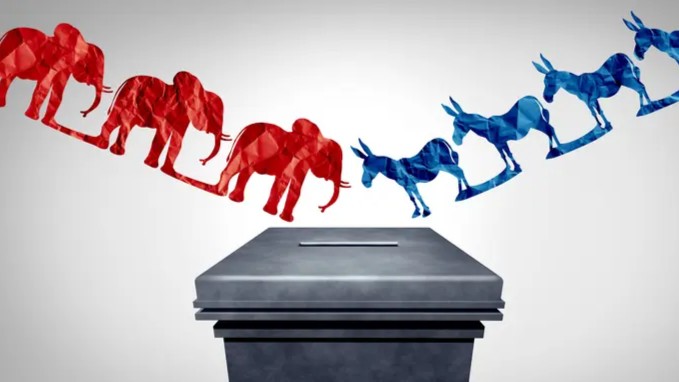
The Democratic-Republican duopoly in our nation’s political system is, to an ever-increasing extent, marginalizing the average American voter. As novel and ever-more-difficult problems arise, defying simplistic answers, compromise and consensus will be essential. The national debt, climate change, artificial intelligence dislocations, to name but a few crises, won’t be solved by mere poll-tested slogans or even by draconian measures imposed by a transient majority. The public “buy-in” demanded to meet and overcome existential threats demands vision, sacrifice, and compromise—all characteristics in short supply in today’s polity.
Structural changes in our elective process won’t provide solutions, but they may make solutions possible. I believe that three electoral reforms—all of which could be implemented for federal elections by Congress—would vastly improve government responsiveness and effectiveness. Not all three are necessary, and even one would help. But counting on our current election process to produce brave and inspiring leadership is not just risky, it’s foolhardy.
The first reform is an all-party primary followed by ranked choice general-election voting. Only Alaska uses this system in its purest form, with a four-way ranked choice general election ballot following a jungle primary open to candidates of any party or none. This system has many variants, such as using Condorcet instead of ranked choice voting to determine the winner. But any system ensuring that candidates with widely varying views are presented to the entire electorate will vastly increase the likelihood that the most broadly acceptable candidate ultimately prevails.
Contrast that with the systems used in most states, where well under half the general-election voters participate in the party primaries. Particularly in those states that limit primary participation to that party’s registered members, the nominating process disadvantages candidates who espouse cooperation and compromise. Already this year, primaries have been won by Senate and congressional candidates who are demonstrably less likely to win in the general election than their vanquished primary opponents would have been. Now that Americans in record numbers are identifying as independents rather than as Democrats, Republicans, or any other party, partisan primaries seem more likely than ever to screen out potential public servants whose policies would meet with the greatest overall satisfaction, not to mention would marshal support for implementing tough but necessary solutions. The demise of a “my party right or wrong” mentality is probably good for America, but that good is mere wasted virtue if it cannot find expression in the existing electoral process.
The second major reform, unnecessary if the first is adopted, is to ease ballot access for independent and third-party candidates. Over the last few decades, the partisan duopoly has thrown up substantial new hurdles in state after state to candidates who do not wish to be labeled as Democrats or Republicans. It would be impossible today for an unsuccessful candidate for a major party nomination to qualify for the ballot everywhere as an independent, as John Anderson did in 1980. Sore loser laws and early filing deadlines give voters no options, even when scandals, health issues, or merely untenable policy positions make a constricted two-party choice broadly unacceptable. Even an amply funded, well-organized, and widely supported effort such as the 2024 No Labels presidential effort faced substantial hurdles in many states and ultimately did not field an alternative candidate.
In Texas, Mike Collier failed to qualify this year as an independent candidate for Lieutenant Governor. Merely to give the voters a choice required him to gather 81,130 signatures in 30 days from registered voters who did not vote in either major party’s primary or runoff or sign a petition for any other party or any other independent candidate for Lieutenant Governor. Texas has had no statewide independent candidate for any office since 2006, and it may never have one again unless the current restrictions are relaxed.
The third major reform is the abolition of, or at least restriction on, gerrymandering. The old saw that “you don’t choose your representative, your representative chooses you” is, in this supercomputing era, more apt than ever. But computers could be used to draw rational, not irrational, district lines. Preexisting political boundaries (like county or municipal lines), legitimate communities of interest, good transportation connections, or even incumbent protection are among the many neutral principles that could be considered by AI-created district lines, although the most interesting configurations might come from requiring districts to be drawn using the fewest miles of linear lines. Alternatively, Congress and the states could experiment with totally different voting systems—cumulative or limited voting in larger districts, for example, to give voice to more diverse views.
Critics might say that any of these suggestions might merely lead to multiple major parties, leading to the perennial deadlock common in some Western European democracies. But our country has a long history of two-party politics, as one or both of the major parties have repeatedly evolved to absorb powerful insurgent movements like the Anti-Masons, the Populists, and the Progressives. Occasionally, new parties have supplanted old ones; in the nineteenth century, National Republicans and Whigs replaced Federalists, and Republicans in turn replaced Whigs. As Yogi Berra knew, “it’s tough to make predictions, especially about the future,” but it seems perverse to reject structural changes because they might increase gridlock. Saying that structural election reforms would make the United States Congress even less effective or assertive than it is now seems akin to the apocryphal counter to 19th-century British electoral change: “Reform? Reform? Aren’t things bad enough already?”
The American people ultimately hold the power to secure the government they want. But the political system should enhance the people’s ability to do so, not erect ever more barriers to impede the people’s will.
About the Author
Thomas R. Phillips
Thomas R. Phillips was Chief Justice of the Supreme Court of Texas 1988-2004. He was a member of the No Labels Texas Executive Committee in 2024. Phillips currently practices law in Austin.
About the Author
Thomas R. Phillips
Thomas R. Phillips was Chief Justice of the Supreme Court of Texas 1988-2004. He was a member of the No Labels Texas Executive Committee in 2024. Phillips currently practices law in Austin.
About the Author
Thomas R. Phillips
Thomas R. Phillips was Chief Justice of the Supreme Court of Texas 1988-2004. He was a member of the No Labels Texas Executive Committee in 2024. Phillips currently practices law in Austin.
More viewpoints in
Elections & Political Parties

Oct 21, 2026
Three Structural Reforms
Thomas R. Phillips
Elections & Political Parties
Oct 21, 2026
Three Structural Reforms
Thomas R. Phillips
Elections & Political Parties
Oct 21, 2026
Three Structural Reforms
Thomas R. Phillips
Elections & Political Parties

Oct 20, 2026
Prelude to a War? The Looming Disempowerment Cycle and the Future of Multiracial Democracy
Bertrall Ross
Elections & Political Parties
Oct 20, 2026
Prelude to a War? The Looming Disempowerment Cycle and the Future of Multiracial Democracy
Bertrall Ross
Elections & Political Parties
Oct 20, 2026
Prelude to a War? The Looming Disempowerment Cycle and the Future of Multiracial Democracy
Bertrall Ross
Elections & Political Parties
Oct 19, 2026
Shaping the Party’s Program in the Primaries
Hans Noel
Elections & Political Parties
Oct 19, 2026
Shaping the Party’s Program in the Primaries
Hans Noel
Elections & Political Parties
Oct 19, 2026
Shaping the Party’s Program in the Primaries
Hans Noel
Elections & Political Parties
More viewpoints in
Elections & Political Parties
Oct 21, 2026
Three Structural Reforms
Thomas R. Phillips
Elections & Political Parties
Oct 20, 2026
Prelude to a War? The Looming Disempowerment Cycle and the Future of Multiracial Democracy
Bertrall Ross
Elections & Political Parties
Oct 19, 2026
Shaping the Party’s Program in the Primaries
Hans Noel
Elections & Political Parties