Oct 19, 2026
Shaping the Party’s Program in the Primaries
Hans Noel
Oct 19, 2026
Shaping the Party’s Program in the Primaries
Hans Noel
Oct 19, 2026
Shaping the Party’s Program in the Primaries
Hans Noel
Oct 19, 2026
Shaping the Party’s Program in the Primaries
Hans Noel
Oct 19, 2026
Shaping the Party’s Program in the Primaries
Hans Noel
Oct 19, 2026
Shaping the Party’s Program in the Primaries
Hans Noel
As we move into the final weeks of the 2026 midterm elections, but before we know the results, it is useful to look back at a summer of nominations contests marked by intra-party conflict, particularly in the Democratic Party.
After November 3, we may hear interpretations of the outcome meant to vindicate one side or the other in those conflicts. If Abdul El-Sayed wins in Michigan, it will be cited as proof that a progressive can win in a swing state. If he loses, it will be proof that even a blue wave can’t lift an extremist into office.
Neither lesson would really be warranted. The truth is that the party includes multiple factions. Success or failure in November and in the next Congress should be judged by how well those factions cooperate when they need to.
A so-called “civil war.”
The story of the Democratic Party’s nominations this cycle was a clash between a set of progressive, often younger, more confrontational candidates on the one hand, and a more cautious set usually backed by the party’s establishment on the other. It has been depicted as a “hostile takeover,” or even a “civil war.”
Dramatic language notwithstanding, there is something real here. But it is both more complicated and less sensational than “civil war” implies.
More complicated because there are more than two factions in the Democratic Party. There are those who want greater commitment to a consistent, ideologically left program, and there are those who think economic struggles are more important than any involving “wokeness.” Those who want to confront a corrupt Trump administration, and those who want to challenge the gerontocracy of the party leadership. And some are committed to a more cautious, more centrist ideological mission, and some think capturing control of Congress is more important than any ideological commitment at all.
All of these cleavages tend to line up to define the insurgent vs. establishment conflict, although imperfectly at best. Sometimes, an outsider overcomes an insider with support from the party establishment. Sometimes the young insurgent is the moderate and the octogenarian incumbent is the ideologue. Sometimes two up-and-coming stars face each other.
The conflict is less sensational than described because it is so ordinary. The Democratic Party is always navigating its internal divisions. So is the Republican Party. Political parties, especially in our two-party system, are coalitions. They bring together different people who want sometimes very different things, but they then collectively decide to prioritize an agenda they can all agree on.
And today, neither party is as internally diverse as it once was. The gap between normie Democrats like Joe Biden and progressive, DSA-aligned Democrats like Zohran Mamdani is not the chasm in the Democratic Party of the 1950s between avowed segregationists like Strom Thurmond and George Wallace and civil rights icons like Fannie Lou Hamer and Adam Clayton Powell.
But just because the differences are small doesn’t mean they are not important. With any internal division, a party needs a way to decide its collective priorities. And like it or not, that is done in the party’s primaries.
What are primaries for?
Primaries of course accomplish several things. They narrow the field to (usually) two candidates, which makes a winner-take-all election simpler. They vet each candidate’s character and qualifications. And they help find the candidate who is the best fit for the district.
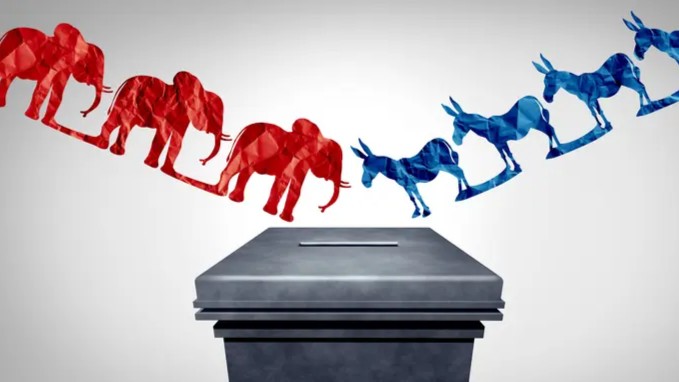
But most importantly, primaries are the ultimate place where intra-party factions face each other.
All those different factions mentioned above are legitimate voices in the Democratic Party, especially because American parties are comparatively open to newcomers. Most of them will surely get some of what they want from a Democratic-controlled legislature, but few will get everything. How will the party set its priorities?
The collection of nominees determines what the party is about in the campaign, and the collection of winners determines what the party is about in office. How well those winners work together determines the success of that party in office.
All of those decisions are made in a series of disconnected primaries.
The balance of “moderates” and “ideologues” running in each party creates the brand that the party takes to the general election. It is not a wise or unwise strategy, because it was no strategy at all. It was just hundreds of party primaries across as many offices.
A more coherent method might involve factional leaders negotiating with each other, or it might draw on a national party-member vote. Primary voters are not necessarily thinking about the big picture, nor are they in a place to negotiate intra-party compromise.
But very few of our institutions are ideal. Party members, for the most part, understand what is happening, and they act accordingly.
Teamwork with a twist
Political parties are teams, but their membership is itself part of the game.
Parties succeed by recruiting new supporters and retaining existing ones. They adopt political positions to do both of those things. And long-standing supporters – the base – have good reason to expect parties to deliver on those promises.
If primaries are where those promises are set, party members need to do three things.
First, they need to embrace national issues in primaries. The choice is not merely who is best for Texas, or for Maine, or for Michigan’s 7th district, but what the national party will be about. There are legitimate concerns about the nationalization of local politics, but it serves an important role in this case.
Second, losing factions need to respect the choice in each contest. By and large, this happens. In most contests, the loser commits to support the primary winner in the general election. Individual politicians may have fragile egos, and factions may resist compromise, but effective parties overcome those limits, both when insiders win and when outsiders win.
Finally, winners of one faction need to be ready to work with winners from other factions when they get to Washington. That isn’t always easy. Republicans in 2023 had such a hard time working together that they struggled to even elect a speaker. The process of holding the coalition together does not end on Election Day.
It is tempting to view primaries as the first round in a two-round election. It is more accurate to view them as one of many places where parties manage their coalitions. Now, the electorate decides which of the two coalitions on offer should be in power.
About the Author
Hans Noel
Hans Noel is a professor at Georgetown University's Department of Government. His research is on political coalitions, political parties and ideology, with a focus on the United States. He is the author of "Political Ideologies and Political Parties in America," and a co-author of "The Party Decides: Presidential Nominations Before and After Reform." He is interested in the implications for understanding parties through focusing on how their policy demands relate to coalition building and coordination.
More viewpoints in
Elections & Political Parties
Oct 19, 2026
Shaping the Party’s Program in the Primaries
Hans Noel
Elections & Political Parties
Oct 19, 2026
Shaping the Party’s Program in the Primaries
Hans Noel
Elections & Political Parties
Oct 19, 2026
Shaping the Party’s Program in the Primaries
Hans Noel
Elections & Political Parties

Oct 15, 2026
Courts, Elections, and Good Faith
Rebecca Green
Elections & Political Parties
Oct 15, 2026
Courts, Elections, and Good Faith
Rebecca Green
Elections & Political Parties
Oct 15, 2026
Courts, Elections, and Good Faith
Rebecca Green
Elections & Political Parties

Oct 14, 2026
It’s Time to Stop Partisan Damage to U.S. Elections
Kevin Johnson
Elections & Political Parties
Oct 14, 2026
It’s Time to Stop Partisan Damage to U.S. Elections
Kevin Johnson
Elections & Political Parties
Oct 14, 2026
It’s Time to Stop Partisan Damage to U.S. Elections
Kevin Johnson
Elections & Political Parties