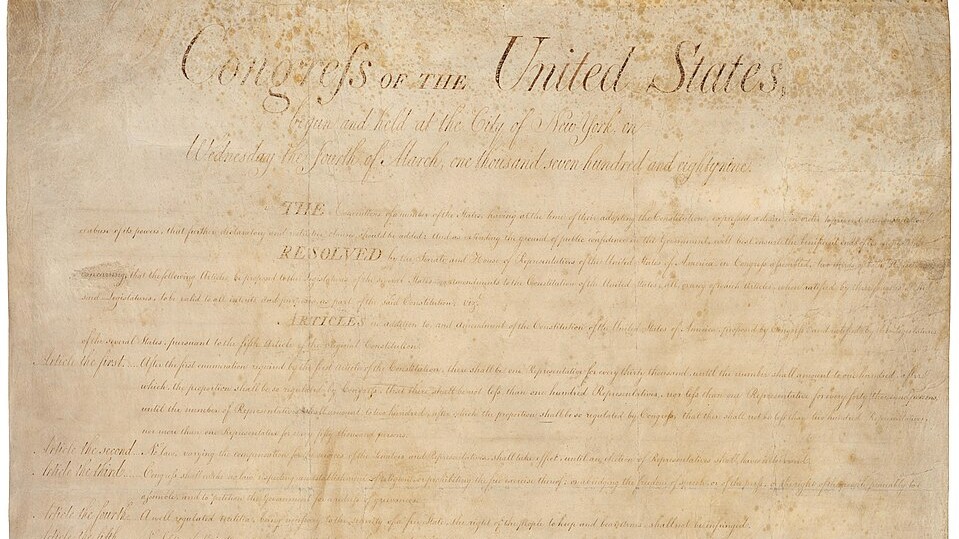
We could end gerrymandering if we only passed the first article of amendment to the Constitution.
What first article? Therein hangs a tale.
Some readers will know that when Congress first proposed the Bill of Rights in 1789, they sent 12 articles of amendment to the States. Only the last 10 were adopted at that time (so our current First Amendment was actually the third article on the list sent to the States). Fewer readers (but still some) will also know that in 1992, 203 years after it was proposed, Article 2 was ratified as the 27th Amendment to the Constitution.
But what about Article 1? Only 11 States ratified it (12 were necessary), and it has lain dormant since then. But like Article 2, it had no expiration date – so if 27 States were to adopt it today, it would become law. And it would end gerrymandering.
Article 1 dealt with the size of the House of Representatives. It would have required that the House grow in size as the country grew. The amendment would have set in stone a mandate that every representative represent no more than 30,000 citizens.
Over time, the maximum representation would have increased until the country grew to a size that would require 200 representatives -- equivalent to 10 million citizens. When the nation grew that large, a final cap would be set such that each Member of the House would represent no more than “fifty thousand persons.”
The original concept behind the proposed amendment was to keep the House responsive to the people it represented. James Madison, for example, thought that the lack of a provision increasing the size of Congress rendered the product “defective.” He contended that to protect the republic and prevent an unrepresentative, oligarchic Congress, the House needed to increase in size regularly, reflecting the country’s growing and shifting population. As the Federalist No. 55 put it, the fear was that if the Congress did not increase in size as the country grew, the representatives: “will not possess a proper knowledge of the local circumstances of their numerous constituents [and] they will be taken from that class of citizens which will sympathize least with the feelings of the mass of the people, and be most likely to aim at a permanent elevation of the few on the depression of the many.”
That sounds familiar. Today, Representatives each have more than 750,000 constituents and seem disconnected from their interests. More troublingly, the creation of a permanent elite representative class seems upon us – and it is to a large degree the consequence of gerrymandering. The “permanent elevation” of a class as leaders is enabled when legislators pick their constituents instead of citizens picking their legislators.
Article 1 would have ameliorated that problem significantly. Had Article 1 become law, then today, with a national population of approximately 347 million, the House of Representatives would have more than 6,900 members. [There is an abstruse argument that a scrivener’s error in the text might reduce this number to 1,600+, but let us leave that aside.]
The number would be cumbersome for legislating, to be sure – and that is a strong argument against this proposal. But a potentially stronger positive argument in its favor is that the multiplication of representatives would make cartoon-like district drawing almost impossible.
Consider: Today, Texas has 38 Representatives in Congress. If the amendment were implemented, that number would increase to just over 600. California, likewise, would see its representation increase to approximately 840 representatives. At this level of localization, it would be nigh-on impossible for a malicious legislature to gerrymander out of existence their opposition. Houston, with its more than 2.3 million residents, would have roughly 45 representative districts. Creative gerrymanderers could pack and crack a few of those. But the overall impact would be to make the sort of imbalance we now see in the House redistricting unattainable.
Is it realistic to think that 27 more States will ratify the Article? Probably not – but it is nice to think that it might be possible and that the fever of a polarized legislature can be broken.
We could end gerrymandering if we only passed the first article of amendment to the Constitution.
What first article? Therein hangs a tale.
Some readers will know that when Congress first proposed the Bill of Rights in 1789, they sent 12 articles of amendment to the States. Only the last 10 were adopted at that time (so our current First Amendment was actually the third article on the list sent to the States). Fewer readers (but still some) will also know that in 1992, 203 years after it was proposed, Article 2 was ratified as the 27th Amendment to the Constitution.
But what about Article 1? Only 11 States ratified it (12 were necessary), and it has lain dormant since then. But like Article 2, it had no expiration date – so if 27 States were to adopt it today, it would become law. And it would end gerrymandering.
Article 1 dealt with the size of the House of Representatives. It would have required that the House grow in size as the country grew. The amendment would have set in stone a mandate that every representative represent no more than 30,000 citizens.
Over time, the maximum representation would have increased until the country grew to a size that would require 200 representatives -- equivalent to 10 million citizens. When the nation grew that large, a final cap would be set such that each Member of the House would represent no more than “fifty thousand persons.”
The original concept behind the proposed amendment was to keep the House responsive to the people it represented. James Madison, for example, thought that the lack of a provision increasing the size of Congress rendered the product “defective.” He contended that to protect the republic and prevent an unrepresentative, oligarchic Congress, the House needed to increase in size regularly, reflecting the country’s growing and shifting population. As the Federalist No. 55 put it, the fear was that if the Congress did not increase in size as the country grew, the representatives: “will not possess a proper knowledge of the local circumstances of their numerous constituents [and] they will be taken from that class of citizens which will sympathize least with the feelings of the mass of the people, and be most likely to aim at a permanent elevation of the few on the depression of the many.”
That sounds familiar. Today, Representatives each have more than 750,000 constituents and seem disconnected from their interests. More troublingly, the creation of a permanent elite representative class seems upon us – and it is to a large degree the consequence of gerrymandering. The “permanent elevation” of a class as leaders is enabled when legislators pick their constituents instead of citizens picking their legislators.
Article 1 would have ameliorated that problem significantly. Had Article 1 become law, then today, with a national population of approximately 347 million, the House of Representatives would have more than 6,900 members. [There is an abstruse argument that a scrivener’s error in the text might reduce this number to 1,600+, but let us leave that aside.]
The number would be cumbersome for legislating, to be sure – and that is a strong argument against this proposal. But a potentially stronger positive argument in its favor is that the multiplication of representatives would make cartoon-like district drawing almost impossible.
Consider: Today, Texas has 38 Representatives in Congress. If the amendment were implemented, that number would increase to just over 600. California, likewise, would see its representation increase to approximately 840 representatives. At this level of localization, it would be nigh-on impossible for a malicious legislature to gerrymander out of existence their opposition. Houston, with its more than 2.3 million residents, would have roughly 45 representative districts. Creative gerrymanderers could pack and crack a few of those. But the overall impact would be to make the sort of imbalance we now see in the House redistricting unattainable.
Is it realistic to think that 27 more States will ratify the Article? Probably not – but it is nice to think that it might be possible and that the fever of a polarized legislature can be broken.
We could end gerrymandering if we only passed the first article of amendment to the Constitution.
What first article? Therein hangs a tale.
Some readers will know that when Congress first proposed the Bill of Rights in 1789, they sent 12 articles of amendment to the States. Only the last 10 were adopted at that time (so our current First Amendment was actually the third article on the list sent to the States). Fewer readers (but still some) will also know that in 1992, 203 years after it was proposed, Article 2 was ratified as the 27th Amendment to the Constitution.
But what about Article 1? Only 11 States ratified it (12 were necessary), and it has lain dormant since then. But like Article 2, it had no expiration date – so if 27 States were to adopt it today, it would become law. And it would end gerrymandering.
Article 1 dealt with the size of the House of Representatives. It would have required that the House grow in size as the country grew. The amendment would have set in stone a mandate that every representative represent no more than 30,000 citizens.
Over time, the maximum representation would have increased until the country grew to a size that would require 200 representatives -- equivalent to 10 million citizens. When the nation grew that large, a final cap would be set such that each Member of the House would represent no more than “fifty thousand persons.”
The original concept behind the proposed amendment was to keep the House responsive to the people it represented. James Madison, for example, thought that the lack of a provision increasing the size of Congress rendered the product “defective.” He contended that to protect the republic and prevent an unrepresentative, oligarchic Congress, the House needed to increase in size regularly, reflecting the country’s growing and shifting population. As the Federalist No. 55 put it, the fear was that if the Congress did not increase in size as the country grew, the representatives: “will not possess a proper knowledge of the local circumstances of their numerous constituents [and] they will be taken from that class of citizens which will sympathize least with the feelings of the mass of the people, and be most likely to aim at a permanent elevation of the few on the depression of the many.”
That sounds familiar. Today, Representatives each have more than 750,000 constituents and seem disconnected from their interests. More troublingly, the creation of a permanent elite representative class seems upon us – and it is to a large degree the consequence of gerrymandering. The “permanent elevation” of a class as leaders is enabled when legislators pick their constituents instead of citizens picking their legislators.
Article 1 would have ameliorated that problem significantly. Had Article 1 become law, then today, with a national population of approximately 347 million, the House of Representatives would have more than 6,900 members. [There is an abstruse argument that a scrivener’s error in the text might reduce this number to 1,600+, but let us leave that aside.]
The number would be cumbersome for legislating, to be sure – and that is a strong argument against this proposal. But a potentially stronger positive argument in its favor is that the multiplication of representatives would make cartoon-like district drawing almost impossible.
Consider: Today, Texas has 38 Representatives in Congress. If the amendment were implemented, that number would increase to just over 600. California, likewise, would see its representation increase to approximately 840 representatives. At this level of localization, it would be nigh-on impossible for a malicious legislature to gerrymander out of existence their opposition. Houston, with its more than 2.3 million residents, would have roughly 45 representative districts. Creative gerrymanderers could pack and crack a few of those. But the overall impact would be to make the sort of imbalance we now see in the House redistricting unattainable.
Is it realistic to think that 27 more States will ratify the Article? Probably not – but it is nice to think that it might be possible and that the fever of a polarized legislature can be broken.
We could end gerrymandering if we only passed the first article of amendment to the Constitution.
What first article? Therein hangs a tale.
Some readers will know that when Congress first proposed the Bill of Rights in 1789, they sent 12 articles of amendment to the States. Only the last 10 were adopted at that time (so our current First Amendment was actually the third article on the list sent to the States). Fewer readers (but still some) will also know that in 1992, 203 years after it was proposed, Article 2 was ratified as the 27th Amendment to the Constitution.
But what about Article 1? Only 11 States ratified it (12 were necessary), and it has lain dormant since then. But like Article 2, it had no expiration date – so if 27 States were to adopt it today, it would become law. And it would end gerrymandering.
Article 1 dealt with the size of the House of Representatives. It would have required that the House grow in size as the country grew. The amendment would have set in stone a mandate that every representative represent no more than 30,000 citizens.
Over time, the maximum representation would have increased until the country grew to a size that would require 200 representatives -- equivalent to 10 million citizens. When the nation grew that large, a final cap would be set such that each Member of the House would represent no more than “fifty thousand persons.”
The original concept behind the proposed amendment was to keep the House responsive to the people it represented. James Madison, for example, thought that the lack of a provision increasing the size of Congress rendered the product “defective.” He contended that to protect the republic and prevent an unrepresentative, oligarchic Congress, the House needed to increase in size regularly, reflecting the country’s growing and shifting population. As the Federalist No. 55 put it, the fear was that if the Congress did not increase in size as the country grew, the representatives: “will not possess a proper knowledge of the local circumstances of their numerous constituents [and] they will be taken from that class of citizens which will sympathize least with the feelings of the mass of the people, and be most likely to aim at a permanent elevation of the few on the depression of the many.”
That sounds familiar. Today, Representatives each have more than 750,000 constituents and seem disconnected from their interests. More troublingly, the creation of a permanent elite representative class seems upon us – and it is to a large degree the consequence of gerrymandering. The “permanent elevation” of a class as leaders is enabled when legislators pick their constituents instead of citizens picking their legislators.
Article 1 would have ameliorated that problem significantly. Had Article 1 become law, then today, with a national population of approximately 347 million, the House of Representatives would have more than 6,900 members. [There is an abstruse argument that a scrivener’s error in the text might reduce this number to 1,600+, but let us leave that aside.]
The number would be cumbersome for legislating, to be sure – and that is a strong argument against this proposal. But a potentially stronger positive argument in its favor is that the multiplication of representatives would make cartoon-like district drawing almost impossible.
Consider: Today, Texas has 38 Representatives in Congress. If the amendment were implemented, that number would increase to just over 600. California, likewise, would see its representation increase to approximately 840 representatives. At this level of localization, it would be nigh-on impossible for a malicious legislature to gerrymander out of existence their opposition. Houston, with its more than 2.3 million residents, would have roughly 45 representative districts. Creative gerrymanderers could pack and crack a few of those. But the overall impact would be to make the sort of imbalance we now see in the House redistricting unattainable.
Is it realistic to think that 27 more States will ratify the Article? Probably not – but it is nice to think that it might be possible and that the fever of a polarized legislature can be broken.
We could end gerrymandering if we only passed the first article of amendment to the Constitution.
What first article? Therein hangs a tale.
Some readers will know that when Congress first proposed the Bill of Rights in 1789, they sent 12 articles of amendment to the States. Only the last 10 were adopted at that time (so our current First Amendment was actually the third article on the list sent to the States). Fewer readers (but still some) will also know that in 1992, 203 years after it was proposed, Article 2 was ratified as the 27th Amendment to the Constitution.
But what about Article 1? Only 11 States ratified it (12 were necessary), and it has lain dormant since then. But like Article 2, it had no expiration date – so if 27 States were to adopt it today, it would become law. And it would end gerrymandering.
Article 1 dealt with the size of the House of Representatives. It would have required that the House grow in size as the country grew. The amendment would have set in stone a mandate that every representative represent no more than 30,000 citizens.
Over time, the maximum representation would have increased until the country grew to a size that would require 200 representatives -- equivalent to 10 million citizens. When the nation grew that large, a final cap would be set such that each Member of the House would represent no more than “fifty thousand persons.”
The original concept behind the proposed amendment was to keep the House responsive to the people it represented. James Madison, for example, thought that the lack of a provision increasing the size of Congress rendered the product “defective.” He contended that to protect the republic and prevent an unrepresentative, oligarchic Congress, the House needed to increase in size regularly, reflecting the country’s growing and shifting population. As the Federalist No. 55 put it, the fear was that if the Congress did not increase in size as the country grew, the representatives: “will not possess a proper knowledge of the local circumstances of their numerous constituents [and] they will be taken from that class of citizens which will sympathize least with the feelings of the mass of the people, and be most likely to aim at a permanent elevation of the few on the depression of the many.”
That sounds familiar. Today, Representatives each have more than 750,000 constituents and seem disconnected from their interests. More troublingly, the creation of a permanent elite representative class seems upon us – and it is to a large degree the consequence of gerrymandering. The “permanent elevation” of a class as leaders is enabled when legislators pick their constituents instead of citizens picking their legislators.
Article 1 would have ameliorated that problem significantly. Had Article 1 become law, then today, with a national population of approximately 347 million, the House of Representatives would have more than 6,900 members. [There is an abstruse argument that a scrivener’s error in the text might reduce this number to 1,600+, but let us leave that aside.]
The number would be cumbersome for legislating, to be sure – and that is a strong argument against this proposal. But a potentially stronger positive argument in its favor is that the multiplication of representatives would make cartoon-like district drawing almost impossible.
Consider: Today, Texas has 38 Representatives in Congress. If the amendment were implemented, that number would increase to just over 600. California, likewise, would see its representation increase to approximately 840 representatives. At this level of localization, it would be nigh-on impossible for a malicious legislature to gerrymander out of existence their opposition. Houston, with its more than 2.3 million residents, would have roughly 45 representative districts. Creative gerrymanderers could pack and crack a few of those. But the overall impact would be to make the sort of imbalance we now see in the House redistricting unattainable.
Is it realistic to think that 27 more States will ratify the Article? Probably not – but it is nice to think that it might be possible and that the fever of a polarized legislature can be broken.
We could end gerrymandering if we only passed the first article of amendment to the Constitution.
What first article? Therein hangs a tale.
Some readers will know that when Congress first proposed the Bill of Rights in 1789, they sent 12 articles of amendment to the States. Only the last 10 were adopted at that time (so our current First Amendment was actually the third article on the list sent to the States). Fewer readers (but still some) will also know that in 1992, 203 years after it was proposed, Article 2 was ratified as the 27th Amendment to the Constitution.
But what about Article 1? Only 11 States ratified it (12 were necessary), and it has lain dormant since then. But like Article 2, it had no expiration date – so if 27 States were to adopt it today, it would become law. And it would end gerrymandering.
Article 1 dealt with the size of the House of Representatives. It would have required that the House grow in size as the country grew. The amendment would have set in stone a mandate that every representative represent no more than 30,000 citizens.
Over time, the maximum representation would have increased until the country grew to a size that would require 200 representatives -- equivalent to 10 million citizens. When the nation grew that large, a final cap would be set such that each Member of the House would represent no more than “fifty thousand persons.”
The original concept behind the proposed amendment was to keep the House responsive to the people it represented. James Madison, for example, thought that the lack of a provision increasing the size of Congress rendered the product “defective.” He contended that to protect the republic and prevent an unrepresentative, oligarchic Congress, the House needed to increase in size regularly, reflecting the country’s growing and shifting population. As the Federalist No. 55 put it, the fear was that if the Congress did not increase in size as the country grew, the representatives: “will not possess a proper knowledge of the local circumstances of their numerous constituents [and] they will be taken from that class of citizens which will sympathize least with the feelings of the mass of the people, and be most likely to aim at a permanent elevation of the few on the depression of the many.”
That sounds familiar. Today, Representatives each have more than 750,000 constituents and seem disconnected from their interests. More troublingly, the creation of a permanent elite representative class seems upon us – and it is to a large degree the consequence of gerrymandering. The “permanent elevation” of a class as leaders is enabled when legislators pick their constituents instead of citizens picking their legislators.
Article 1 would have ameliorated that problem significantly. Had Article 1 become law, then today, with a national population of approximately 347 million, the House of Representatives would have more than 6,900 members. [There is an abstruse argument that a scrivener’s error in the text might reduce this number to 1,600+, but let us leave that aside.]
The number would be cumbersome for legislating, to be sure – and that is a strong argument against this proposal. But a potentially stronger positive argument in its favor is that the multiplication of representatives would make cartoon-like district drawing almost impossible.
Consider: Today, Texas has 38 Representatives in Congress. If the amendment were implemented, that number would increase to just over 600. California, likewise, would see its representation increase to approximately 840 representatives. At this level of localization, it would be nigh-on impossible for a malicious legislature to gerrymander out of existence their opposition. Houston, with its more than 2.3 million residents, would have roughly 45 representative districts. Creative gerrymanderers could pack and crack a few of those. But the overall impact would be to make the sort of imbalance we now see in the House redistricting unattainable.
Is it realistic to think that 27 more States will ratify the Article? Probably not – but it is nice to think that it might be possible and that the fever of a polarized legislature can be broken.
About the Author
Paul Rosenzweig
Paul Rosenzweig is the founder of Red Branch Consulting PLLC, a homeland security consulting company. He formerly served as Deputy Assistant Secretary for Policy in the Department of Homeland Security. Rosenzweig is a Professorial Lecturer in Law at George Washington University, an advisor to and former member of the American Bar Association Standing Committee on Law and National Security, and a Contributing Editor of the Lawfare blog.
About the Author
Paul Rosenzweig
Paul Rosenzweig is the founder of Red Branch Consulting PLLC, a homeland security consulting company. He formerly served as Deputy Assistant Secretary for Policy in the Department of Homeland Security. Rosenzweig is a Professorial Lecturer in Law at George Washington University, an advisor to and former member of the American Bar Association Standing Committee on Law and National Security, and a Contributing Editor of the Lawfare blog.
About the Author
Paul Rosenzweig
Paul Rosenzweig is the founder of Red Branch Consulting PLLC, a homeland security consulting company. He formerly served as Deputy Assistant Secretary for Policy in the Department of Homeland Security. Rosenzweig is a Professorial Lecturer in Law at George Washington University, an advisor to and former member of the American Bar Association Standing Committee on Law and National Security, and a Contributing Editor of the Lawfare blog.
More viewpoints in
Elections & Political Parties

Oct 9, 2026
What Is a Patriotic American to Do in This Chaotic, but Historically Consequential Election? Voting Isn’t Optional and It Isn’t Enough.
Roberta Cooper Ramo
Elections & Political Parties
Oct 9, 2026
What Is a Patriotic American to Do in This Chaotic, but Historically Consequential Election? Voting Isn’t Optional and It Isn’t Enough.
Roberta Cooper Ramo
Elections & Political Parties
Oct 9, 2026
What Is a Patriotic American to Do in This Chaotic, but Historically Consequential Election? Voting Isn’t Optional and It Isn’t Enough.
Roberta Cooper Ramo
Elections & Political Parties

Oct 8, 2026
Small Donors Aren’t the Democratic Cure We Imagined
Raymond J. La Raja
Elections & Political Parties
Oct 8, 2026
Small Donors Aren’t the Democratic Cure We Imagined
Raymond J. La Raja
Elections & Political Parties
Oct 8, 2026
Small Donors Aren’t the Democratic Cure We Imagined
Raymond J. La Raja
Elections & Political Parties

Oct 7, 2026
The Politics of AI: A Campaign Finance Reform Proposal
Bob Bauer
Elections & Political Parties
Oct 7, 2026
The Politics of AI: A Campaign Finance Reform Proposal
Bob Bauer
Elections & Political Parties
Oct 7, 2026
The Politics of AI: A Campaign Finance Reform Proposal
Bob Bauer
Elections & Political Parties
More viewpoints in
Elections & Political Parties
Oct 9, 2026
What Is a Patriotic American to Do in This Chaotic, but Historically Consequential Election? Voting Isn’t Optional and It Isn’t Enough.
Roberta Cooper Ramo
Elections & Political Parties
Oct 8, 2026
Small Donors Aren’t the Democratic Cure We Imagined
Raymond J. La Raja
Elections & Political Parties
Oct 7, 2026
The Politics of AI: A Campaign Finance Reform Proposal
Bob Bauer
Elections & Political Parties
More viewpoints in
Elections & Political Parties
Oct 9, 2026
What Is a Patriotic American to Do in This Chaotic, but Historically Consequential Election? Voting Isn’t Optional and It Isn’t Enough.
Roberta Cooper Ramo
Elections & Political Parties
Oct 8, 2026
Small Donors Aren’t the Democratic Cure We Imagined
Raymond J. La Raja
Elections & Political Parties
Oct 7, 2026
The Politics of AI: A Campaign Finance Reform Proposal
Bob Bauer
Elections & Political Parties
More viewpoints in
Elections & Political Parties
Oct 9, 2026
What Is a Patriotic American to Do in This Chaotic, but Historically Consequential Election? Voting Isn’t Optional and It Isn’t Enough.
Roberta Cooper Ramo
Elections & Political Parties
Oct 8, 2026
Small Donors Aren’t the Democratic Cure We Imagined
Raymond J. La Raja
Elections & Political Parties
Oct 7, 2026
The Politics of AI: A Campaign Finance Reform Proposal
Bob Bauer
Elections & Political Parties