Dec 3, 2025
Election Law Blog: Caleb Nelson’s Essay for the NYU Democracy Project Cited in 11 Briefs in Trump v. Slaughter
Richard Pildes
Dec 3, 2025
Election Law Blog: Caleb Nelson’s Essay for the NYU Democracy Project Cited in 11 Briefs in Trump v. Slaughter
Richard Pildes
Dec 3, 2025
Election Law Blog: Caleb Nelson’s Essay for the NYU Democracy Project Cited in 11 Briefs in Trump v. Slaughter
Richard Pildes
Dec 3, 2025
Election Law Blog: Caleb Nelson’s Essay for the NYU Democracy Project Cited in 11 Briefs in Trump v. Slaughter
Richard Pildes
Dec 3, 2025
Election Law Blog: Caleb Nelson’s Essay for the NYU Democracy Project Cited in 11 Briefs in Trump v. Slaughter
Richard Pildes
Dec 3, 2025
Election Law Blog: Caleb Nelson’s Essay for the NYU Democracy Project Cited in 11 Briefs in Trump v. Slaughter
Richard Pildes
Editor's Note: This post originally appeared on the Election Law Blog.
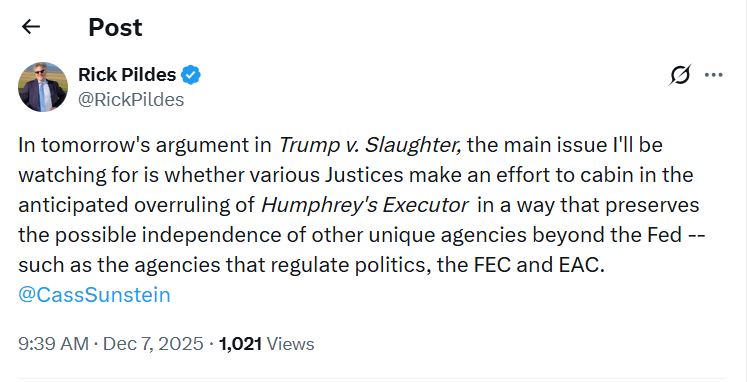
Here is my earlier post on Caleb Nelson’s essay for the NYU Democracy Project. His essay is cited by both parties in this case, Trump and Slaughter, as well as in nine amicus briefs. Caleb Nelson, a leading originalist scholar, argues originalism does not support the unitary executive branch theory. As I said on X, I will be listening in today’s argument for whether any of the Justices recognize the possibility that agencies/commissions other than the Fed Reserve might still constitutionally be made independent, such as the agencies that regulate politics (the FEC and EAC), even if the Court overrules Humphrey’s Executor.
Editor's Note: This post originally appeared on the Election Law Blog.
Here is my earlier post on Caleb Nelson’s essay for the NYU Democracy Project. His essay is cited by both parties in this case, Trump and Slaughter, as well as in nine amicus briefs. Caleb Nelson, a leading originalist scholar, argues originalism does not support the unitary executive branch theory. As I said on X, I will be listening in today’s argument for whether any of the Justices recognize the possibility that agencies/commissions other than the Fed Reserve might still constitutionally be made independent, such as the agencies that regulate politics (the FEC and EAC), even if the Court overrules Humphrey’s Executor.
Editor's Note: This post originally appeared on the Election Law Blog.
Here is my earlier post on Caleb Nelson’s essay for the NYU Democracy Project. His essay is cited by both parties in this case, Trump and Slaughter, as well as in nine amicus briefs. Caleb Nelson, a leading originalist scholar, argues originalism does not support the unitary executive branch theory. As I said on X, I will be listening in today’s argument for whether any of the Justices recognize the possibility that agencies/commissions other than the Fed Reserve might still constitutionally be made independent, such as the agencies that regulate politics (the FEC and EAC), even if the Court overrules Humphrey’s Executor.
Editor's Note: This post originally appeared on the Election Law Blog.
Here is my earlier post on Caleb Nelson’s essay for the NYU Democracy Project. His essay is cited by both parties in this case, Trump and Slaughter, as well as in nine amicus briefs. Caleb Nelson, a leading originalist scholar, argues originalism does not support the unitary executive branch theory. As I said on X, I will be listening in today’s argument for whether any of the Justices recognize the possibility that agencies/commissions other than the Fed Reserve might still constitutionally be made independent, such as the agencies that regulate politics (the FEC and EAC), even if the Court overrules Humphrey’s Executor.
Editor's Note: This post originally appeared on the Election Law Blog.
Here is my earlier post on Caleb Nelson’s essay for the NYU Democracy Project. His essay is cited by both parties in this case, Trump and Slaughter, as well as in nine amicus briefs. Caleb Nelson, a leading originalist scholar, argues originalism does not support the unitary executive branch theory. As I said on X, I will be listening in today’s argument for whether any of the Justices recognize the possibility that agencies/commissions other than the Fed Reserve might still constitutionally be made independent, such as the agencies that regulate politics (the FEC and EAC), even if the Court overrules Humphrey’s Executor.
Editor's Note: This post originally appeared on the Election Law Blog.
Here is my earlier post on Caleb Nelson’s essay for the NYU Democracy Project. His essay is cited by both parties in this case, Trump and Slaughter, as well as in nine amicus briefs. Caleb Nelson, a leading originalist scholar, argues originalism does not support the unitary executive branch theory. As I said on X, I will be listening in today’s argument for whether any of the Justices recognize the possibility that agencies/commissions other than the Fed Reserve might still constitutionally be made independent, such as the agencies that regulate politics (the FEC and EAC), even if the Court overrules Humphrey’s Executor.
About the Author
Richard Pildes
Pildes is a founding Faculty Director of the Democracy Project and Sudler Family Professor of Constitutional Law at NYU School of Law. He is the nation’s most cited scholar on election law, a leading expert on American government and democratic governance worldwide, co-editor of Electoral Reform in the United States: Reforms for Combatting Polarization and Extremism (2025), and a member of President Biden’s Commission on the Supreme Court of the United States and the bipartisan ABA Task Force on American democracy.
About the Author
Richard Pildes
Pildes is a founding Faculty Director of the Democracy Project and Sudler Family Professor of Constitutional Law at NYU School of Law. He is the nation’s most cited scholar on election law, a leading expert on American government and democratic governance worldwide, co-editor of Electoral Reform in the United States: Reforms for Combatting Polarization and Extremism (2025), and a member of President Biden’s Commission on the Supreme Court of the United States and the bipartisan ABA Task Force on American democracy.
About the Author
Richard Pildes
Pildes is a founding Faculty Director of the Democracy Project and Sudler Family Professor of Constitutional Law at NYU School of Law. He is the nation’s most cited scholar on election law, a leading expert on American government and democratic governance worldwide, co-editor of Electoral Reform in the United States: Reforms for Combatting Polarization and Extremism (2025), and a member of President Biden’s Commission on the Supreme Court of the United States and the bipartisan ABA Task Force on American democracy.
More viewpoints in
Congress, The President & The Courts

Oct 5, 2026
Special Feature: Magyar’s Constitutional Moment
Wojciech Sadurski
Congress, The President & The Courts
Oct 5, 2026
Special Feature: Magyar’s Constitutional Moment
Wojciech Sadurski
Congress, The President & The Courts
Oct 5, 2026
Special Feature: Magyar’s Constitutional Moment
Wojciech Sadurski
Congress, The President & The Courts

Sep 3, 2026
The Case for Factions
James Wallner
,
Soren Dayton
Congress, The President & The Courts
Sep 3, 2026
The Case for Factions
James Wallner
,
Soren Dayton
Congress, The President & The Courts
Sep 3, 2026
The Case for Factions
James Wallner
,
Soren Dayton
Congress, The President & The Courts

Sep 1, 2026
How to Get Justice, and Judges, Closer to the People
Julio Ríos-Figueroa
Congress, The President & The Courts
Sep 1, 2026
How to Get Justice, and Judges, Closer to the People
Julio Ríos-Figueroa
Congress, The President & The Courts
Sep 1, 2026
How to Get Justice, and Judges, Closer to the People
Julio Ríos-Figueroa
Congress, The President & The Courts
More viewpoints in
Congress, The President & The Courts
Oct 5, 2026
Special Feature: Magyar’s Constitutional Moment
Wojciech Sadurski
Congress, The President & The Courts
Sep 3, 2026
The Case for Factions
James Wallner
,
Soren Dayton
Congress, The President & The Courts
Sep 1, 2026
How to Get Justice, and Judges, Closer to the People
Julio Ríos-Figueroa
Congress, The President & The Courts
More viewpoints in
Congress, The President & The Courts
Oct 5, 2026
Special Feature: Magyar’s Constitutional Moment
Wojciech Sadurski
Congress, The President & The Courts
Sep 3, 2026
The Case for Factions
James Wallner
,
Soren Dayton
Congress, The President & The Courts
Sep 1, 2026
How to Get Justice, and Judges, Closer to the People
Julio Ríos-Figueroa
Congress, The President & The Courts
More viewpoints in
Congress, The President & The Courts
Oct 5, 2026
Special Feature: Magyar’s Constitutional Moment
Wojciech Sadurski
Congress, The President & The Courts
Sep 3, 2026
The Case for Factions
James Wallner
,
Soren Dayton
Congress, The President & The Courts
Sep 1, 2026
How to Get Justice, and Judges, Closer to the People
Julio Ríos-Figueroa
Congress, The President & The Courts